Cross Docking Services Explained: How Freight Moves Faster Through Miami
Miami is one of the most active freight gateways in the United States, connecting domestic distribution networks with international trade lanes. As shipment volumes increase and delivery windows tighten, freight forwarders and trucking companies need transfer strategies that reduce dwell time without sacrificing accuracy.
One logistics model that continues to grow across South Florida is cross docking. When implemented correctly, cross docking reduces handling, limits storage dependency, and increases supply chain velocity—especially in high-throughput markets like Miami where appointment windows and lane capacity can change quickly.
This guide explains how cross docking works, why it matters in Miami, and how logistics operators can apply it to improve performance across freight forwarding and trucking operations.
What Is Cross Docking?
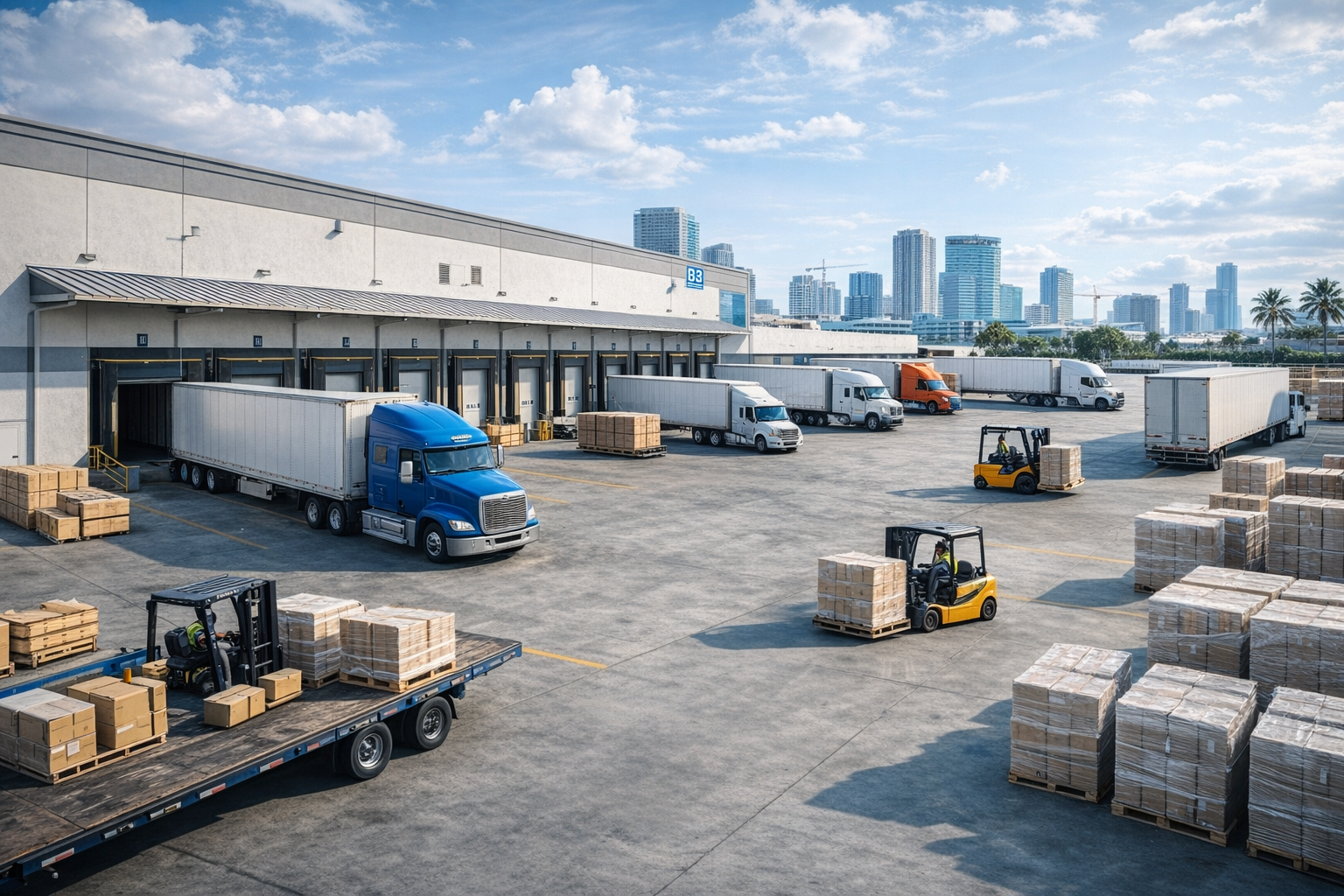
Cross docking is a logistics process in which inbound freight is received, verified, sorted, and transferred directly to outbound transportation with minimal or no storage time. Unlike traditional warehousing, cargo doesn’t sit in inventory. Instead, it flows through the facility quickly— often within hours—reducing dwell time and cutting unnecessary touches.
Professional cross docking workflows typically include:
- Inbound receiving from ports, airports, or regional trucking lanes
- Documentation matching and verification checkpoints
- Sorting by destination, route, or outbound carrier
- Load consolidation or deconsolidation
- Immediate outbound dispatch
The goal is operational speed with control: move freight fast while maintaining chain-of-custody discipline.
Why Miami Is a Strategic Cross Docking Hub
Miami is a high-velocity freight environment. Ocean and air cargo flows into South Florida, then moves into regional and national distribution lanes. In that setting, storage can become a bottleneck: it adds time, cost, and additional handling events that increase risk.
Cross docking is often the better fit when the priority is to transfer freight rapidly from inbound to outbound—especially when appointment windows are tight, carriers are scheduled back-to-back, or the freight must move immediately into downstream routes.
How Cross Docking Benefits Freight Forwarders
Freight forwarders depend on coordinated handoffs. Cross docking supports that coordination by creating a structured transfer point that reduces dwell time while preserving accuracy through verification steps.
Faster transit times
When inbound freight is transferred directly into outbound transportation, forwarders can shorten total transit time. This matters for time-sensitive cargo, retail replenishment, and shipments with strict delivery commitments.
Smarter consolidation and deconsolidation
Cross docking is ideal for consolidation programs: multiple inbound shipments can be built into stronger outbound loads, or inbound containerized freight can be deconsolidated into region-specific routes. This improves utilization and can reduce cost per unit moved.
Lower storage dependency
Storage adds fixed cost and time. Cross docking reduces reliance on long-term warehousing when the objective is rapid transfer rather than inventory holding.
Better control at transfer points
A professional cross dock introduces checkpoints—count verification, label scans, mismatch flags—that reduce misroutes, short shipments, and claims.
If you want a reference cross docking capability page that integrates with broader logistics workflows, see: International 3PL cross docking services . International 3PL cross docking services ocean freight operations in Miami It outlines how cross docking can align with freight forwarding and downstream distribution.
How Cross Docking Supports Trucking Companies
For trucking companies operating in South Florida, time is capacity. Cross docking helps carriers keep equipment moving by reducing wait time and minimizing “stuck freight” situations that disrupt routes and driver hours.
- Faster turn times: Less time waiting for staging or storage and more time moving freight.
- Reduced deadhead miles: Better inbound/outbound matching can lower empty miles.
- Schedule stability: Appointment-based inbound/outbound flow supports route planning.
- Lower cargo risk: Fewer touches reduce handling-related damage and claims.
In a market like Miami, those gains can translate directly into improved utilization, better on-time performance, and higher customer retention.
Cross Docking Process in Miami: Step by Step
While each operation varies based on freight profile and outbound routing, high-performance cross docks follow a standardized sequence designed to protect chain-of-custody and maintain speed.
- Inbound Receiving: Appointment validation, arrival logging, and initial condition checks to identify exceptions early.
- Sorting & Verification: Scanning/labeling, destination sorting, mismatch controls, and chain-of-custody discipline.
- Load Consolidation: Combine or split freight by route/carrier to optimize outbound utilization (LTL/FTL).
- Outbound Dispatch: Final checks, staged loading, and departure control to hit appointment windows and improve ETAs.
When Cross Docking Makes the Most Sense
Cross docking performs best when freight is time-sensitive, documentation is accurate, and outbound schedules are confirmed. It is commonly used for redistribution, consolidation, and transfer programs that cannot absorb long dwell times.
Cross docking may not be the best fit if freight requires long-term holding, extended inspections, temperature conditioning, or complex kitting. In those cases, staging or warehousing workflows may be more appropriate.
Cross Docking as Part of a Broader Logistics Strategy
Many operators treat cross docking as a component of a larger supply chain strategy rather than a standalone service. When aligned with freight forwarding, drayage, and distribution, cross docking becomes a powerful tool for accelerating flow while maintaining control.
If your freight plan includes consolidation, deconsolidation, or rapid redistribution through South Florida, a cross dock can reduce friction at key transfer points and help you scale throughput without expanding storage footprint.
Choosing the Right Cross Docking Partner in Miami
A cross dock should be evaluated as a strategic transfer point, not a generic warehouse. Freight forwarders and carriers should look for:
- Proximity to Miami freight corridors, ports, and airports
- Verification discipline and documentation controls
- Ability to handle LTL/FTL, consolidation, and redistribution
- Appointment management and predictable outbound execution
- Scalability when volumes increase
The best partners operate with standardized processes, clear exception handling, and the ability to coordinate inbound and outbound schedules without creating delays.
Final Thoughts
In high-velocity markets like Miami, cross docking is a proven method for reducing dwell time and improving throughput. For freight forwarders, it improves consolidation and transit reliability. For trucking companies, it improves turn times and schedule stability. When executed with the right controls, cross docking becomes a measurable competitive advantage.
For a detailed cross docking capability reference page, visit:
Cross Docking
.
Miami Cross Docking: What You’re Optimizing
FAQ
What is cross docking in logistics?
Cross docking is a process where inbound freight is transferred directly to outbound transportation with minimal or no storage time, reducing handling and speeding up delivery.
Why is cross docking important in Miami?
Miami is a major freight gateway with high cargo volumes and tight delivery windows. Cross docking helps reduce congestion, dwell time, and storage costs in a fast-moving market.
Is cross docking suitable for freight forwarders?
Yes. Freight forwarders use cross docking to consolidate, deconsolidate, and redistribute shipments efficiently while improving transit times and reducing handling touches.
How does cross docking help trucking companies?
It improves driver turn times, reduces deadhead miles, stabilizes schedules, and lowers cargo handling risk by limiting touches and time in storage.
When should cross docking not be used?
Freight requiring long-term storage, extended inspections, or complex kitting may be better served by staging or warehousing workflows rather than a pure cross dock model.